

A key signature shows what key you are in by using accidentals (sharps and flats). The accidentals depend on the type of scale and what note(root) it starts from. All you have to do is alter the notes from the root to fit the scale and you will get the accidentals which is the key signature.
For example, the major scale is made up with these notes.
R 2 3 – 4 5 6 7 – 8
There are 2 half steps in the major scale which are between the 3,4 and the 7,8 notes. The rest are all whole steps. So, all you have to do is to fit the notes according to the scale depending on what the root is.
Let’s try the easiest example, the C major.

Just make sure that each note fits the scale degree after the root(C). Since naturally the notes E,F and B,C are half steps, there is no need to put any accidentals. This is why the C major scale does not have any accidentals.
Let’s try Ab major.

Make sure that the notes fit the scale. The root and the 2 note is a whole step away. To make it a whole step from Ab, it would be a Bb. But you may ask “why not A#?”. Since the root is a b(Flat), we keep the rest of the notes in the scale using flats so it has a sense of unity. So here how it looks.

Here is the D major key.
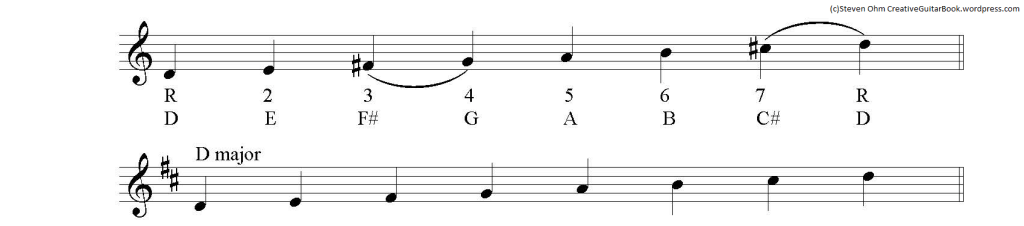
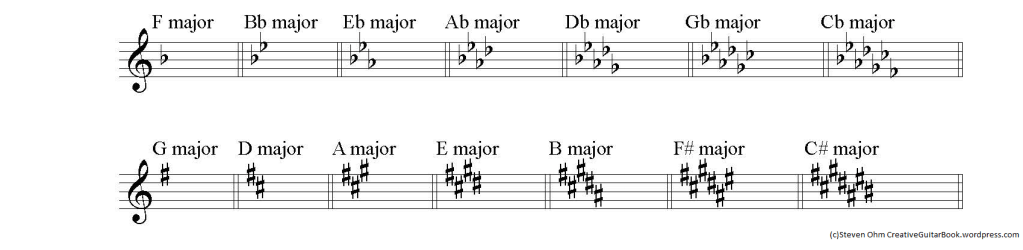
Each flat key and sharp key have their own order of writing the accidentals.

Here are the rest of the key signatures. Remember, C major does not have any accidentals.
Images and content is ©Steven Ohm(2020). All rights reserved.
 Takecoda Music LLC
Leave a comment